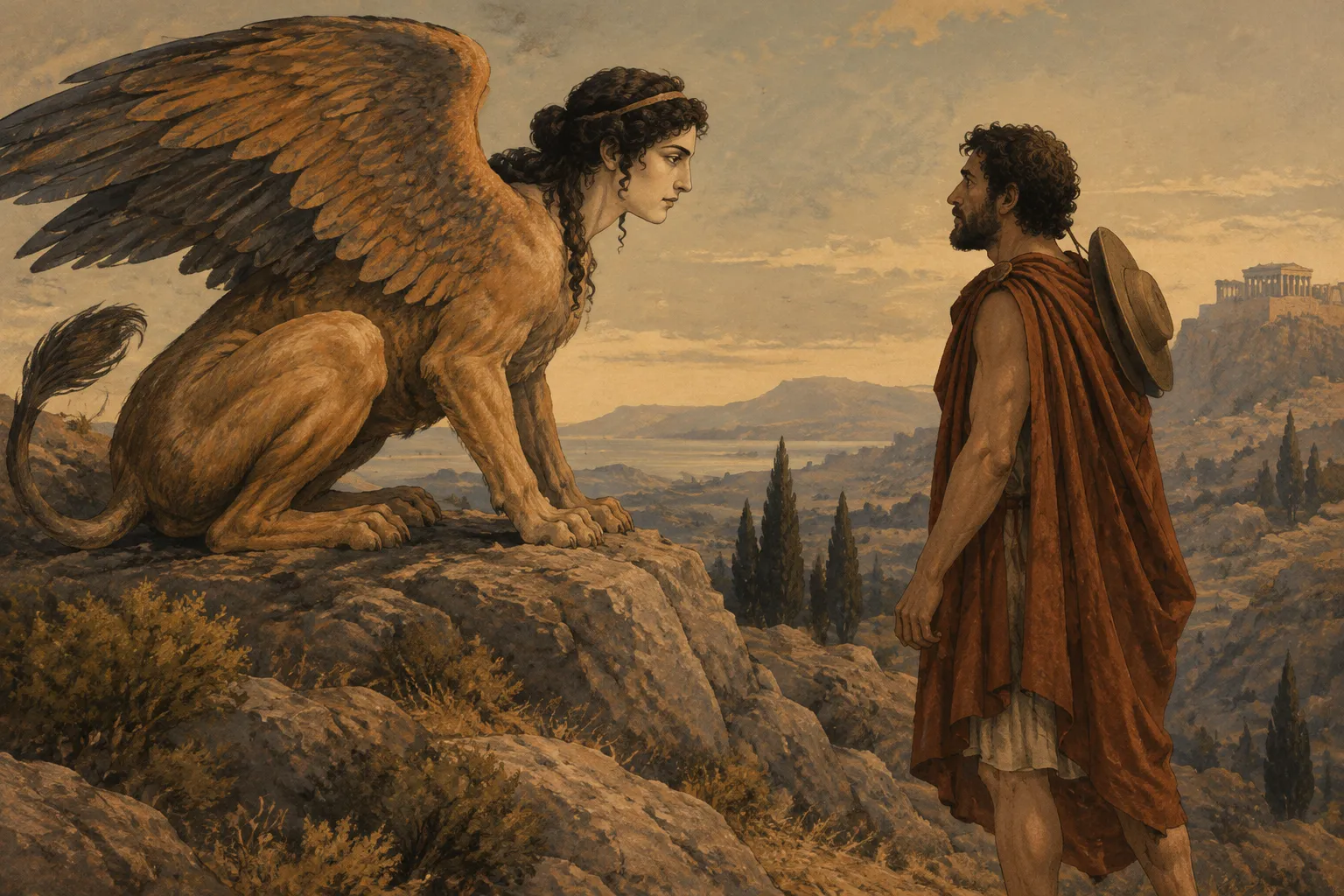
A human face above a lion’s paws does not necessarily mean a riddle is coming. The Metropolitan Museum of Art’s granite sphinx of Hatshepsut represents an Egyptian ruler. The winged creature confronting Oedipus on a Greek vase belongs to a story about a dangerous encounter. Their resemblance invites comparison, but it does not make them interchangeable.
The useful question is therefore not simply what a sphinx looks like. It is what this particular sphinx does, whose authority it embodies, and what kind of evidence preserves it. Putting an Egyptian royal sculpture beside a Greek narrative image reveals how easily a familiar creature-name can conceal different meanings.
One name is not one biography
Start with two specific witnesses rather than a universal definition. The Met dates its sphinx of Hatshepsut to about 1473–1458 BCE. The National Gallery of Victoria discusses an Attic red-figure oil vessel dated 450–430 BCE, attributed to the Achilles Painter, depicting Oedipus and the Sphinx. These objects are separated by roughly a millennium as well as by cultural setting.
That gap matters to the comparison. We are not watching two artists illustrate the same episode. Nor should the Greek story be used as an instruction manual for interpreting Egyptian sculpture. The safer approach is to establish each object’s identity before asking what their similarities might help us notice.
Think of the shared outline as the beginning of a question rather than its answer. Does the human head identify a ruler or give a monster an unsettling familiarity? Does the powerful animal body express legitimate strength or make an encounter dangerous? Those are interpretive questions, not properties that anatomy alone can settle.
Hatshepsut’s sphinx: the ruler in a powerful body
The Met’s sculpture combines a lion’s body with Hatshepsut’s human head, wearing the royal nemes headcloth and ceremonial false beard. It was one of at least six granite sphinxes at her mortuary temple at Deir el-Bahri. The museum interprets its attentive posture as that of a guardian: still, but ready to confront an enemy. Its date and royal identity are documented in the collection record and accompanying commentary.
These details point toward a reading of concentrated royal power. The head identifies the authority; the animal body gives that authority a formidable physical presence. This is an interpretation of the combination, not a claim that the sculpture delivers a verbal message. Nothing in this object’s museum documentation presents it as a questioner waiting to catch a visitor out.
Hatshepsut also complicates any quick division between a supposedly male Egyptian sphinx and a female Greek one. Here a female pharaoh appears through royal imagery that includes a false beard. The relevant distinction is not simply the sex of the face. It is the identity and office being represented. The Met explains that her statues could depict her both as an ideal king and as a woman.
For a viewer, the practical lesson is restraint. Before imagining a voice emerging from the stone, ask whom the sculpture represents. In this instance, importing Oedipus’ riddle would replace the object’s documented royal identity with an unrelated narrative expectation.
The Greek encounter: a question with consequences
On the Melbourne vase, the Sphinx has a woman’s head, a lion’s body, and wings. She confronts Oedipus, who wears traveling clothes. Heather Jackson’s study of the scene connects it with the familiar story: the Sphinx troubles Thebes, Oedipus answers her challenge, and the grateful city rewards him with its throne and Jocasta as queen. That apparent success helps fulfill the terrible circumstances he has tried to escape.
The contrast with Hatshepsut is especially revealing here. One figure represents a reigning sovereign; the other participates in an encounter that brings a man to sovereignty. In the Egyptian object, royal identity is already present. In the Greek narrative, the confrontation helps produce a new political identity for Oedipus. This is a comparison of their functions, not an argument that one was deliberately designed as the opposite of the other.
It also changes how we understand victory. A reader can interpret the riddle scene as a warning against confusing a successful answer with complete understanding. Oedipus can resolve the question before him without grasping the larger circumstances of his own life. The achievement remains real, but its consequences exceed what he understands at the moment.
That makes this encounter different from a straightforward monster-killing episode. For another comparison of creatures whose similar roles need careful unpacking, see why Ladon and Fafnir guard treasure. The useful habit is the same: begin with the particular story, not a generic monster category.
Even the famous riddle needs a source
The familiar answer is a human being, understood through changing stages of life. But the wording should not be treated as a fixed quotation from Sophocles. The University of Pittsburgh’s teaching discussion of the riddle emphasizes that Oedipus Rex refers to the Sphinx without specifying the riddle’s contents. It also distinguishes the popular morning–noon–evening formulation from ancient versions emphasizing one voice and changing numbers of feet.
This distinction separates three things readers can easily collapse: the confrontation in the story, the wording preserved by a particular witness, and the modern form someone happens to remember. A retelling can communicate the central puzzle clearly while still being misleading if it presents its wording as a line from a play that does not contain it.
The Pittsburgh page also proposes broader interpretations of the puzzle. Those are readings to consider, not necessary additions to every account. The strongest point for this comparison is simpler: even on the Greek side, there is no reason to assume that every reference to the Sphinx supplies an identical script.
Source awareness does not diminish the story’s force. It lets us be precise about where that force comes from. An artist can evoke a confrontation without recording its dialogue; a drama can rely on a remembered victory without restaging it. Neither kind of witness should be made to provide evidence it does not actually contain.
Compare the roles without flattening the traditions
The Greek evidence itself resists a clean equation between sphinx and hostile riddler. Jackson notes that sphinxes also appeared on Greek votive and grave monuments. The monster in Oedipus’ story therefore cannot stand for every Greek use of the form, any more than Hatshepsut’s sculpture can explain every Egyptian sphinx.
This leaves us with a comparison more useful than a rigid national contrast. Ask three questions: who is this figure, what is it doing here, and what kind of witness tells us so? An object record can establish a sculpture’s material and royal identity. A painted vessel can preserve a visual treatment of an encounter. A literary discussion can distinguish a drama’s allusions from later or alternative formulations.
These sources do not, by themselves, establish a complete route of transmission between Egypt and Greece. Resemblance is not enough to reconstruct that history. The narrower conclusion is secure and rewarding: the same broad human-and-lion combination can participate in very different ways of representing power.
So, do all sphinxes ask riddles? Not on the evidence considered here. Hatshepsut’s sphinx invites us to recognize royal presence; the encounter with Oedipus invites us to consider knowledge and its limits. Keeping those roles distinct makes both examples more interesting than a single imaginary species with a standard set of habits.
Sources and further reading
- The Metropolitan Museum of Art: Sphinx of Hatshepsut — object documentation and interpretation of its royal and guardian imagery.
- Heather Jackson, The Riddle of the Sphinx: An Attic red-figure lekythos — Greek visual evidence and discussion of the narrative.
- University of Pittsburgh: The riddle of the Sphinx — teaching notes distinguishing the play’s references from versions of the puzzle.


