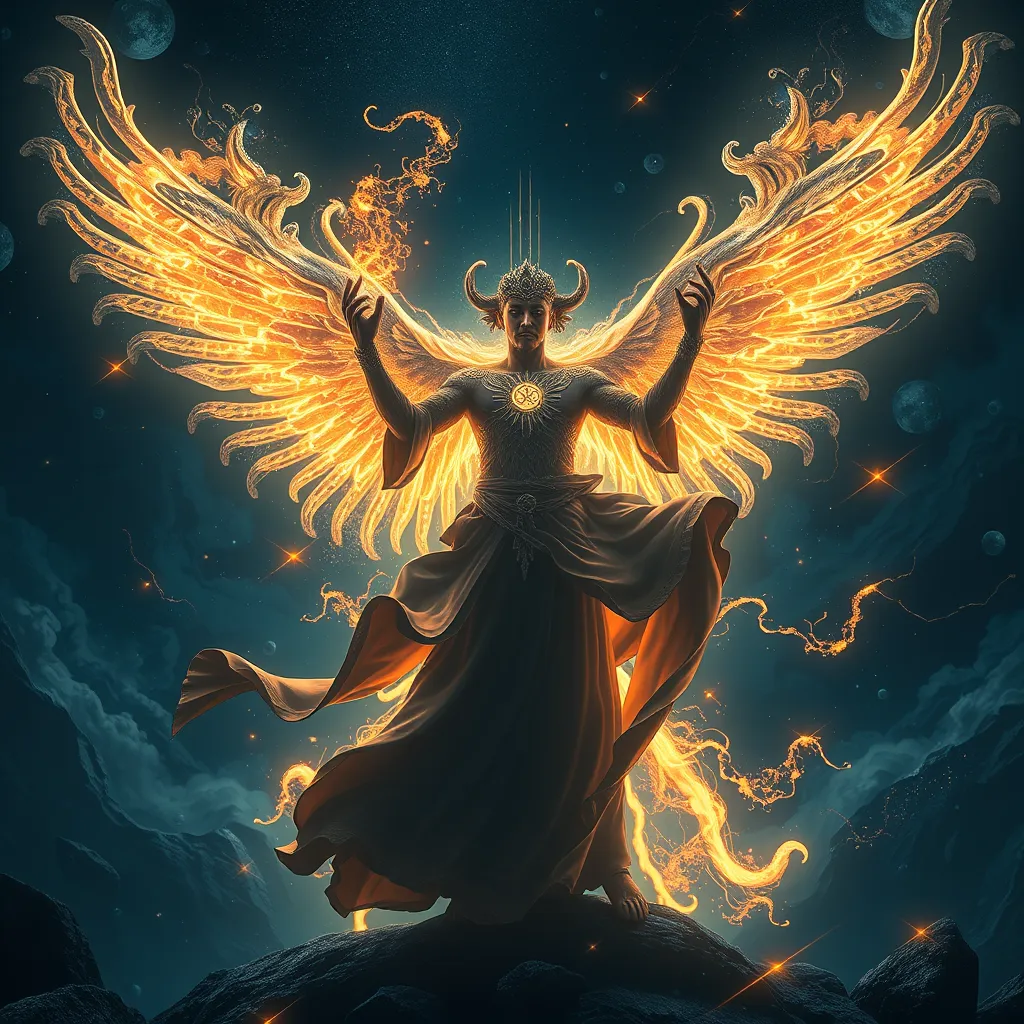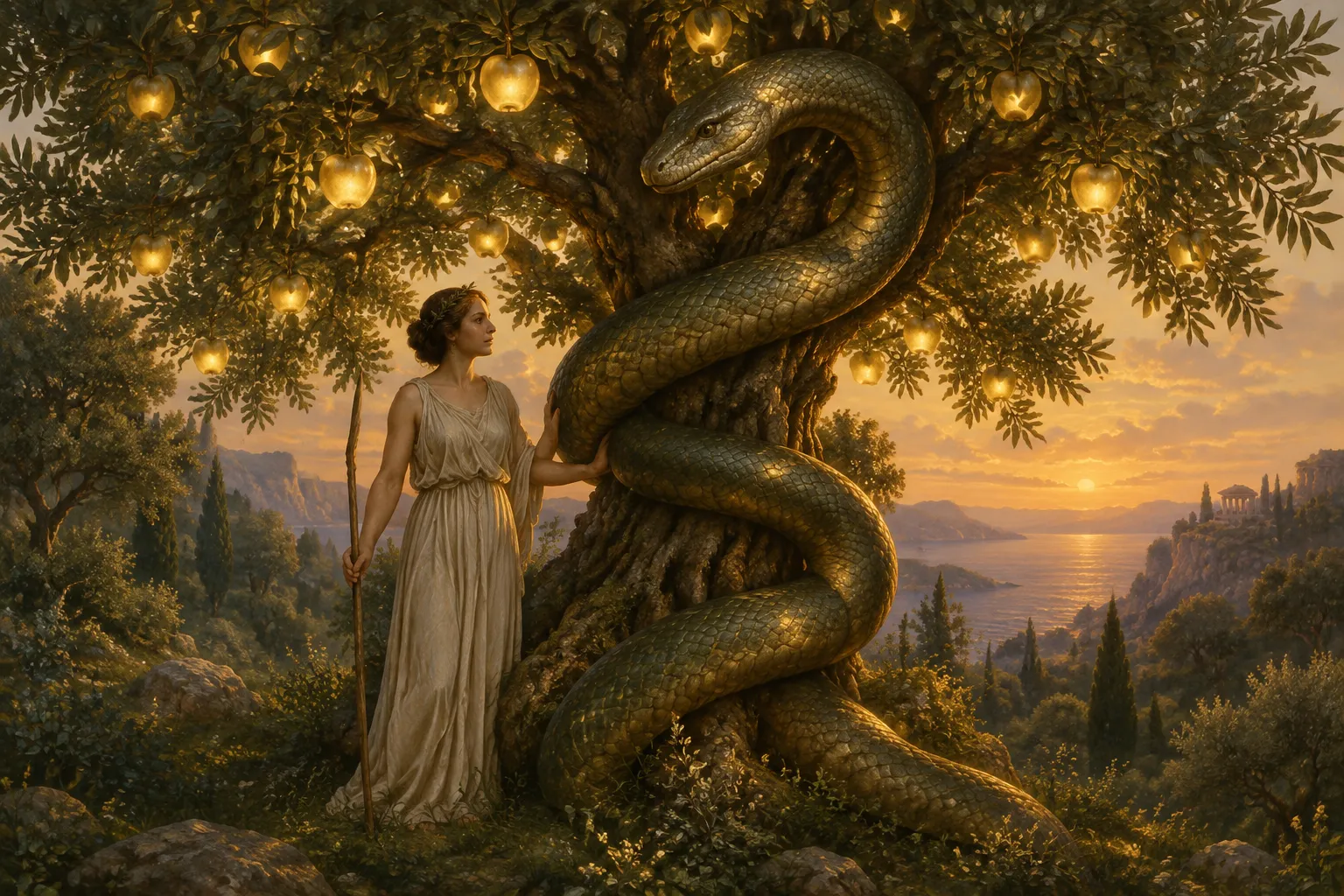
A dragon beside treasure seems to explain itself: the monster wants the gold, and the hero must kill it. But set the Greek serpent Ladon beside Fafnir in the Old Norse Völsunga saga, and that familiar picture becomes less straightforward. One guards extraordinary fruit in a divine garden; the other possesses wealth that carries a deadly warning. Their resemblance raises a better question than whether dragons are greedy: what relationship does each creature have to the thing it guards?
The comparison below treats these as distinct stories, not fragments of one universal dragon myth. Its payoff is a practical way to read a monster encounter: ask whose property is at stake, who describes the guardian as an enemy, and whether removing it actually makes the prize safe.
1. First separate the witnesses
There is no single Greek account to place opposite a single timeless Norse belief. For the apples episode, the mythographic collection attributed to Apollodorus, Library 2.5.11, preserves alternative ways Heracles obtains them. Theoi also gathers passages about the guardian from different ancient authors, including the third-century BCE poet Apollonius Rhodius. On the Norse side, the anonymous thirteenth-century Icelandic Völsunga saga supplies the narrative used here, in William Morris and Eiríkr Magnússon’s English translation.
These distinctions matter because comparison can accidentally manufacture certainty. If we combine every Greek variant into one continuous adventure, then compare it with a modern retelling of Sigurd, we are comparing editorial inventions. Keeping the witnesses visible lets us notice something more interesting: even within one tradition, the same guardian need not serve exactly the same narrative purpose.
We should therefore use resemblance as a starting point, not a verdict. A serpent and a valuable object form a recognizable arrangement. They do not, by themselves, establish a shared origin, identical symbolism, or the same judgment about the hero.
2. Ladon: a guardian, not simply a collector
In Apollodorus’s account of the golden apples, Earth presented the fruit to Zeus after his marriage to Hera. A hundred-headed, many-voiced dragon guards it alongside the Hesperides. The principal route to success involves Atlas obtaining three apples while Heracles temporarily supports the heavens. The text also records the alternative that Heracles kills the serpent and picks the fruit himself. Ultimately, Athena returns the apples: they cannot simply be deposited elsewhere.
Read this arrangement as a problem of access. The dragon is not introduced here as a robber who has gathered somebody else’s money into a private pile. It occupies a guarding position within an already extraordinary setting. On that reading, overcoming the obstacle demonstrates the hero’s reach, but does not automatically establish his right to keep the reward.
The return is especially revealing. Imagine a version that ended with Heracles planting the apples in his own orchard: it would make possession the lasting result of the adventure. The actual ending invites a different interpretation. The hero can accomplish the retrieval without permanently converting the guarded object into ordinary property.
This is why “treasure” needs care. Calling both apples and gold treasure is useful for comparison, but it can smuggle in the assumption that everything valuable is interchangeable, portable wealth. Here, the ending resists that assumption.
3. What changes when the garden mourns?
Another Greek witness complicates the apparent triumph. In Apollonius Rhodius’s Argonautica 4.1390 onward, excerpted by Theoi, the Argonauts arrive after Heracles has struck down Ladon. The serpent lies beside the tree, poisoned by his arrows. The Hesperid Aegle describes the visitor as a bringer of sorrow who killed their guardian and stole their apples.
The interpretive opportunity is not to declare Heracles secretly villainous in every account. It is to notice the change of viewpoint. A deed celebrated as an achievement from outside the garden can appear as destruction from within it. The guardian’s death has witnesses who do not share the victor’s interests.
Try mentally removing the word “monster” from the scene. What remains is an intruder, a dead watchkeeper, grieving inhabitants, and missing valuables. Restore the heroic framework, and the same event becomes a remarkable exploit. Neither description alone exhausts what this passage allows a reader to see.
That tension makes Ladon more than a difficulty rating attached to a prize. In this telling, the guardian helps expose the cost of another character’s achievement. Success has an aftermath, and the people left behind are allowed to describe it.
4. Fafnir: killing the keeper does not cure the gold
In chapters XVIII–XIX of the Völsunga saga, Sigurd attacks Fafnir from a pit beneath the dragon’s route to water. Mortally wounded, Fafnir speaks with him and warns that the gold will destroy its possessors. Sigurd refuses to abandon it. After tasting the dragon’s heart-blood, he understands birds, whose warnings reveal Regin’s treachery; he then kills Regin.
Consider the narrative logic rather than treating the warning as decorative atmosphere. If the dragon were the whole problem, his death would settle the matter. Instead, the encounter asks the victorious hero to evaluate a danger that cannot be solved by the same sword stroke. Killing a possessor is not the same action as neutralizing what he possesses.
Fafnir’s speech also complicates the division between brute force and understanding. The adversary can explain a risk that the conqueror chooses to accept. We need not conclude that every word from a dying enemy is trustworthy to recognize the dramatic pressure: physical superiority does not make Sigurd immune to consequences.
The next danger involves trust, not merely scales and venom. In my reading, that movement keeps the treasure from becoming a simple reward token. Victory opens another problem of judgment. The hero must decide not only what he can take, but whose advice he should believe while taking it.
5. Three questions to ask of any treasure guardian
The most productive comparison is therefore not “Greek and Norse dragons both love gold.” It is a set of questions that preserves the differences:
- What kind of possession is involved? Distinguish a guarded divine object from wealth that a new owner hopes to acquire.
- Whose viewpoint defines success? Listen for inhabitants, companions, and enemies whose interests differ from the hero’s.
- What survives the guardian’s defeat? Look for obligations, warnings, or dangers that force cannot remove.
These questions also complement our discussion of whether Otherworld food is always a trap: in both comparisons, treating an extraordinary object as an ordinary prize can obscure the story’s central distinction. The useful question is not simply whether something is desirable, but what acquiring it commits someone to.
Ladon and Fafnir need not mean the same thing to illuminate each other. Read together, they invite us to distinguish access from ownership, conquest from safety, and a hero’s achievement from everybody else’s experience of it. The dragon draws our attention. What happens to the treasure tells us what kind of victory we have witnessed.
Sources and further reading
- Apollodorus, Library, Book 2, translated by J. G. Frazer; especially 2.5.11.
- Theoi’s Hesperian Dragon collection; especially the excerpt from Apollonius Rhodius, Argonautica 4.1390 onward, translated by E. V. Rieu.
- The Story of the Volsungs, translated by William Morris and Eiríkr Magnússon; especially chapters XVIII–XIX.